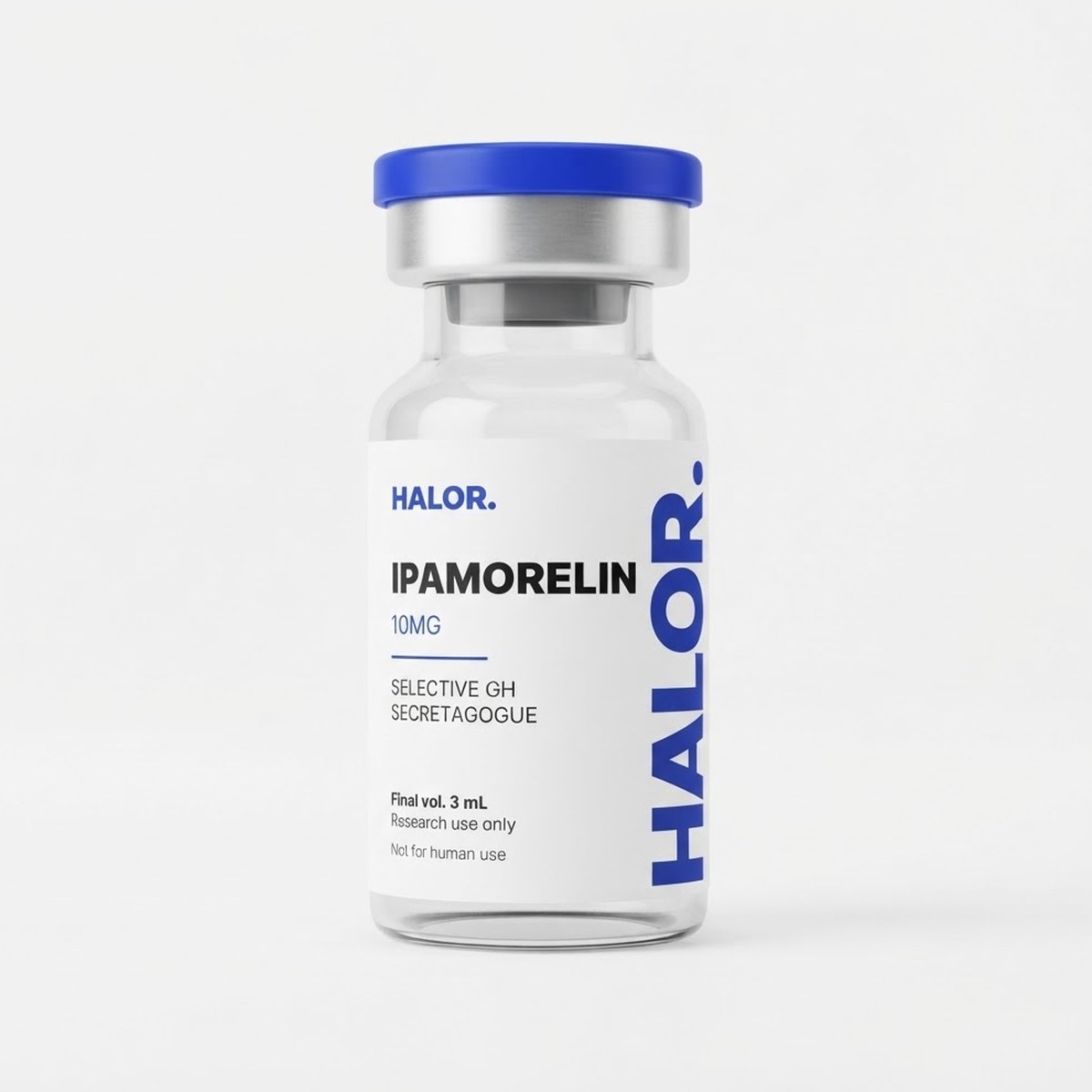
Ipamorelin, 1998: GH Up, Cortisol And Prolactin Unchanged
The paper that introduced ipamorelin showed a pentapeptide releasing growth hormone with the potency of GHRP-6 but without the ACTH, cortisol or prolactin rise, even at doses more than 200 times the effective dose.

What was studied
Earlier growth-hormone-releasing peptides such as GHRP-6 and GHRP-2 released GH efficiently but also pushed ACTH and cortisol. Raun and colleagues at Novo Nordisk screened a series of compounds lacking the central Ala-Trp dipeptide of GHRP-1 and characterized the most selective one, ipamorelin, in pituitary cells, rats and pigs.
What the data shows
- In primary rat pituitary cells ipamorelin released GH with an EC50 of 1.3 nmol/L and an efficacy of 85% relative to GHRP-6.
- In anesthetized rats the ED50 was 80 nmol/kg; in conscious swine, 2.3 nmol/kg, both comparable to GHRP-6.
- Antagonist experiments showed the effect runs through a GHRP-type receptor, not the GHRH receptor.
- None of the secretagogues tested changed FSH, LH, prolactin or TSH. GHRP-6 and GHRP-2 raised ACTH and cortisol; ipamorelin did not, even at more than 200 times its GH ED50.
This is a pharmacology paper in animals. The clinical program that followed was discontinued, and ipamorelin is not an approved medicine. The selectivity finding is a receptor-level observation, not an outcome claim.
Why it matters for research
The 1998 paper defines what "selective GH secretagogue" means and provides the dose–response numbers still used to design ghrelin-receptor assays. It is the reference for laboratories comparing secretagogues on GH release and off-target hormone output.
Raun K, Hansen BS, Johansen NL, Thøgersen H, Madsen K, Ankersen M, Andersen PH. Ipamorelin, the first selective growth hormone secretagogue. Eur J Endocrinol. 1998;139(5):552-61. doi.org/10.1530/eje.0.1390552
Bibliographic data retrieved from PubMed.
Summary prepared for laboratory research context. Halor products are sold for research use only and are not for human or veterinary use. Nothing on this page is medical advice.